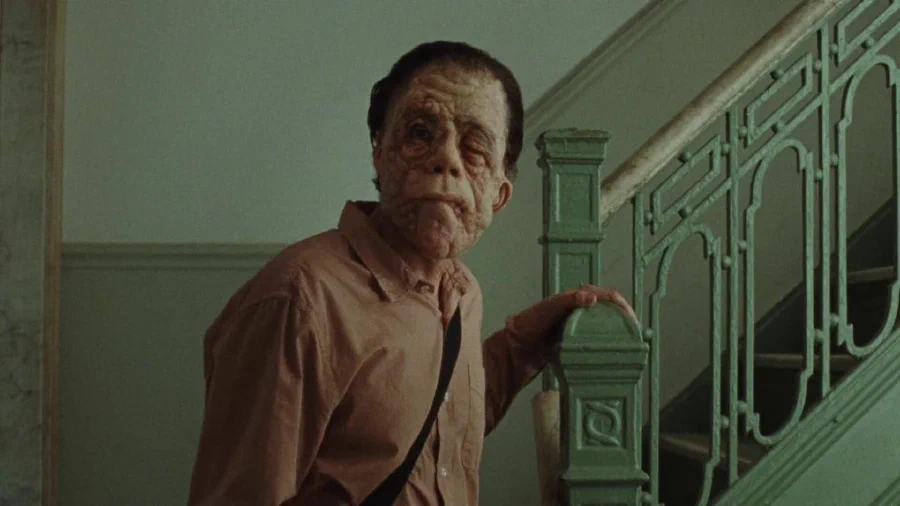
A 2024 film directed by Aaron Schimberg, this is a film capable of changing its nature just like its protagonist. The story centres on Edward, an aspiring actor suffering from neurofibromatosis, a condition that has caused him to have a facial deformity and which seems to be the greatest obstacle of his life.
Edward finds it difficult to relate to other people as he speaks in a low voice, averts his gaze, walks slowly and seems to constantly feel as though he is being watched. His career never seems to take off either and the few jobs he manages to get appear to be linked solely to his appearance and his mental prison.
Things change when he meets Ingrid, his new neighbour, an aspiring writer and playwright. A different kind of relationship develops between the two, with Ingrid appearing to feel something more than mere friendship for Edward. Despite a few moments of closeness, including physical ones, he never manages to take the decisive step. It almost seems as though every chance of happiness is thwarted by his insecurity and the belief that he cannot truly be loved by others. In more than one scene, we see Edward longing for what he observes in other people’s lives, but when the opportunity finally presents itself, he fails to seize it.
At this very moment, people begin to question what seemed to be the most obvious premise of the story: his appearance. If it all came down to his face, then all he would need to do is change it. Edward therefore decides to undergo an experimental treatment that might finally cure him of his condition. Following the experiment and numerous side effects, the treatment proves successful and Edward is literally reborn as Guy Moratz. He then decides to make everyone believe that Edward has committed suicide and sets out to live the life he has always wanted.
Guy becomes a successful estate agent, has success with women and finally manages to navigate the world with a confidence that the old Edward would never have had.

One day, whilst walking past a small theatre, he spots a poster for a small play called “Edward”, written by Ingrid. He decides to turn up for the audition wearing an old mask made by the doctors before his treatment. He is chosen to play Edward, the very person he has tried so hard to leave behind, but whom he seems unable to let go of.
At this point, the film takes another turn. Although everything seemed to be going well, Oswald’s arrival throws it all into disarray.
Oswald is a man suffering from the same condition as Edward, but he embodies exactly what Edward has never managed to be. Right from the start, he proves to be outgoing, charismatic, kind and multi-talented, and he is not at all self-conscious about his appearance. It is precisely this way of life that makes his presence a problem in Guy’s life. From this moment on, Guy begins a descent into despair and resorts to extreme measures as a way of expressing the hatred he has built up inside himself.
It almost seems as though the entire film can be divided into two main parts. In the first, the focus is on perspective, as the viewer is forced to see the world through Edward’s eyes, but the interesting thing is that it is also made clear that the problem runs much deeper within him. In fact, Edward has built a prison for himself, and if anyone tries to help him escape, he chooses to stay inside.
History teaches us that changing one’s outward appearance is virtually pointless if everything inside remains the same. Edward may change his face, but he cannot make years of insecurity and self-loathing simply vanish into thin air.
The story continues with the second part, which takes the message to an even greater extreme. Although Guy is leading a successful life, deep down he knows that he is not the real Edward. His obsession with his former identity resurfaces through the theatre and manifests itself in his hatred for Oswald.
In essence, Schimberg has managed to craft a story that begins as a reflection on discrimination and physical appearance, but which gradually evolves into a reflection on identity and self-acceptance.