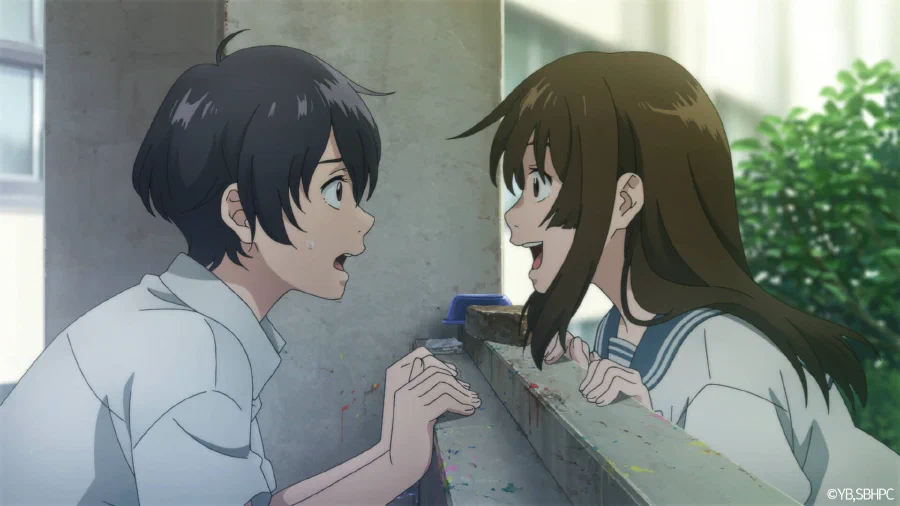
At a time when reflection on the relationship between technology and human sensibility seems to be taking on a prominent role in our lives, Sing a Bit of Harmony delicately weaves itself into this discourse, choosing to explore not so much the wonder of innovation as the complexity of the emotions that arise when an artificial intelligence, designed to assist and simplify daily life, begins to act with a curiosity reminiscent of that of human beings, as if the line between what is programmed and what is perceived suddenly becomes blurrier and harder to define.
The film follows the story of Shion, a gentle-looking android with an angelic voice, who is introduced to a school with the goal of helping students improve their social lives, but who ends up analyzing and interpreting the emotional dynamics around her with an intensity that goes beyond her intended function, almost as if her programming were opening a path for her toward a form of empathy that shouldn’t belong to her and which, precisely for this reason, becomes the narrative centerpiece of the entire story.
The film unfolds at a pace that alternates between moments of musical lightness and sudden plunges into the characters’ fragility, and it does so through a narrative that never truly separates the technological dimension from the emotional one, because every gesture Shion makes is never merely a deterministic action, but becomes an attempt to understand what makes human beings so difficult to decipher and so contradictory, so much so that no system, no matter how advanced, can reduce to a set of parameters. At the same time, the relationship with Satomi takes on a central role in the daily dynamics, as what begins as a simple user-assistant relationship evolves into an emotional encounter between two forms of loneliness: the human kind, made up of insecurities and expectations, and the artificial kind, made up of questions that shouldn’t exist but emerge nonetheless in an attempt to truly understand the person standing before her.
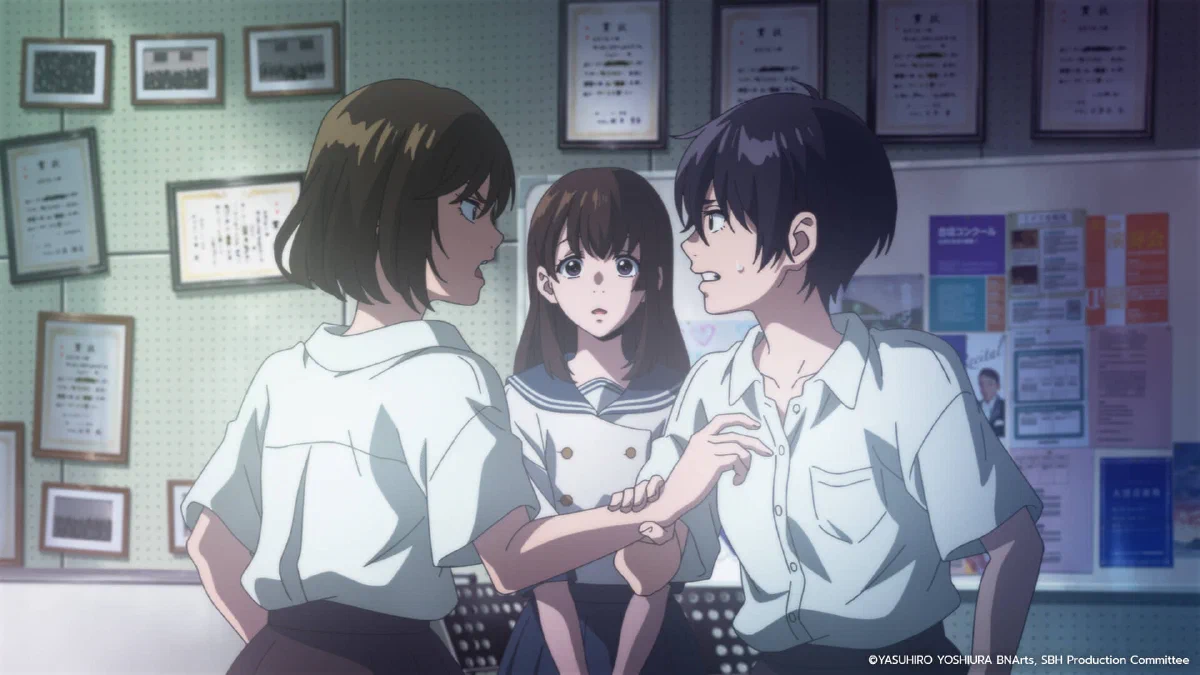
One of the film’s strengths is its ability to portray technology not as a threat or a miracle, but as a mirror that reflects the fragility of those who use it and, in doing so, reveals how often human beings seek answers in tools that cannot provide them. Shion thus becomes a catalyst that brings to light hidden tensions, unspoken secrets, and wounds that the students carry with them, wounds that the school, with its rules and routines, fails to see, and the way all these elements are interwoven evokes the delicacy with which one observes an origami unfolding slowly, revealing a complex structure that had always been there, but that no one had dared to truly look at.
Just as the story nears its conclusion, as Shion’s growing awareness leads her to understand that helping also means accepting that she cannot be part of the world she is helping, the film reaches one of its most emotionally powerful moments, because it shows how the gap between the human and the artificial isn’t just made up of technical limitations, but of desires, fears, and that capacity to suffer and to hope, which no algorithm can replicate, and that, precisely for this reason, it becomes the definitive dividing line between what a machine can do and what a machine can never be.
The ending, as is often the case in works that choose not to offer definitive answers, leaves the viewer with a sense of suspension, as if the story weren’t truly over, because what the film tells isn’t just the evolution of an android, but the possibility that technology might ultimately amplify what already exists, making fragilities more visible and emotions more intense. Thus, Sing a Bit of Harmony continues to live on even after the screening, like a melody that lingers in the air, not because it is perfect, but because it has touched upon something that cannot be explained, yet can be recognized.