In his 2025 film, Ugo Bienvenu constructs a narrative universe populated by characters who, whilst set within a science-fiction context, embody themes that are profoundly human. Arco, Iris and the robot accompanying them are not merely characters serving the plot, but represent three complementary perspectives: the curious innocence of childhood, the emotional resilience of those growing up in a fragmented world, and the ability of machines to fill the voids left by human beings. Through these three figures, the film explores the relationship between technological progress, social fragility and the evolution of emotions, laying the foundations for a story that combines adventure and social commentary.
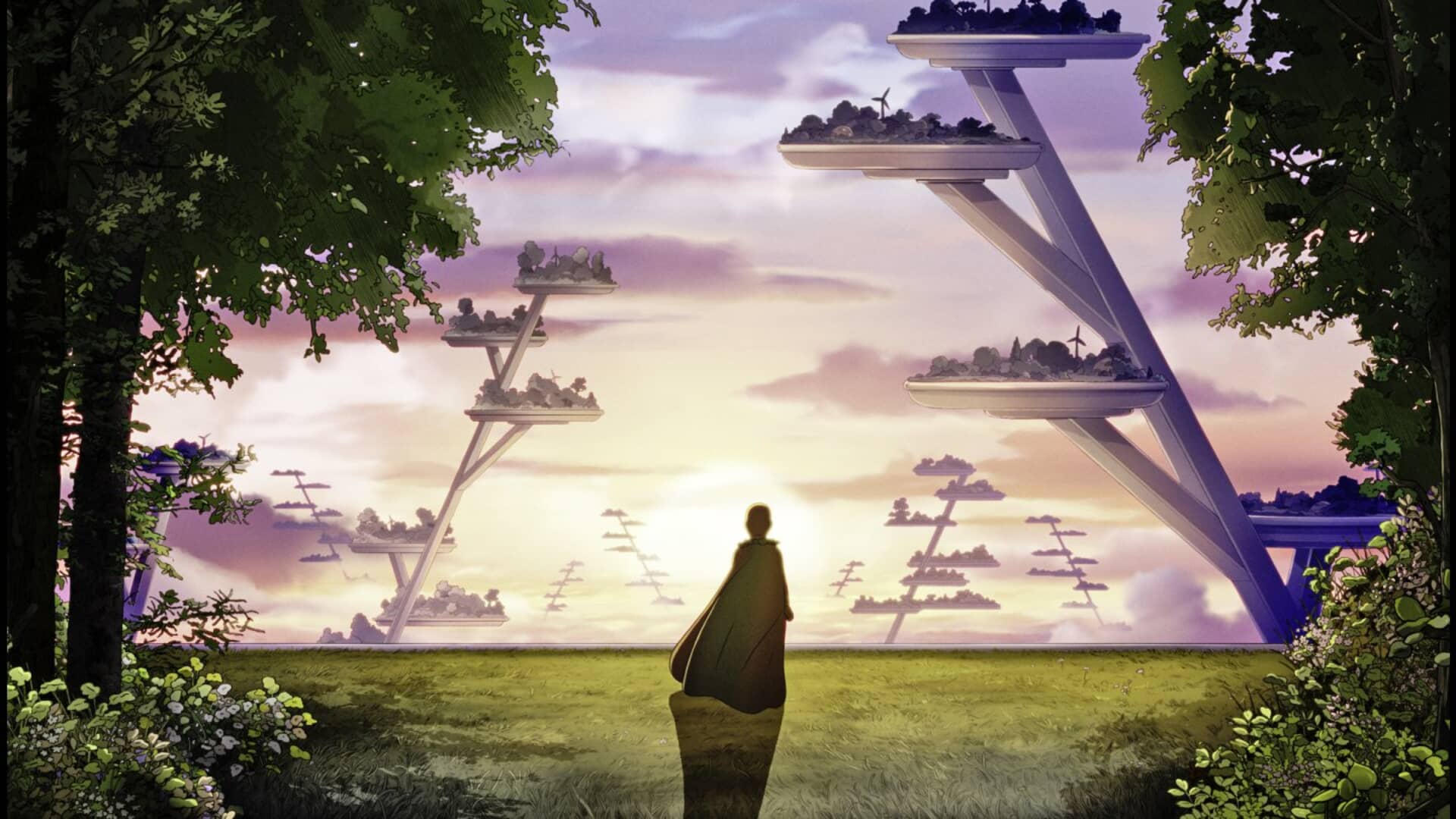
Arco is a boy living in the distant year 3000, a future in which society has been forced to move into imposing structures that rise above the clouds. Every floor of these structures is entirely dedicated to agriculture and livestock farming, as if to suggest that, despite technological evolution (evident in scenes of daily life), the latter has been relegated to the background in favour of a more ‘natural’ lifestyle. The element that sets this story apart from many others is the presence of a rainbow cloak which, when worn together with a special gem placed on the head, allows the wearer to fly and even to travel through time.
As is often the case in this sort of story, the protagonist manages to get hold of one of these cloaks and, due to his inexperience, finds himself accidentally catapulted into the year 2075 whilst searching for dinosaurs. The landing is catastrophic, but Iris, a resourceful young girl who has to cope with the emotional void caused by her parents’ absence due to work commitments, comes to his aid, even though they are ‘present’ at mealtimes thanks to advanced technologies based on holograms.
The plot itself begins with the meeting of the two protagonists, who will spend the rest of the film searching for the gem lost during the impact and figuring out a way to enable Arco to return home. To further complicate matters, a group of antagonists steps in, determined to verify that Arco is indeed a time traveller.
Beyond the plot, what sets the film apart is the seriousness with which animation is treated as a communicative art form. Whilst it is perfectly accessible to an audience of both children and adults, whilst watching it one senses a certain solemnity arising from the visual style and the evident care taken in the artwork.
The numerous social critiques scattered throughout the film by the director also deserve attention. The year 2075 is depicted as one of the worst periods in human history, as natural disasters and incessant fires have forced people to live in dwellings protected by enormous domes. Robots have replaced humans even in the most humanistic roles, such as that of teachers. Society seems to have lost all sense of emotion, and this is evident even in the design of the adult characters, all of whom wear glasses that accentuate their alienation.
The most striking thing is that these criticisms aren’t spelled out through expository dialogue, but emerge through small, everyday gestures. At last, a work that doesn’t feel the need to explain everything to the audience!
Even the robot who looks after Iris goes beyond mere algorithmic functioning, revealing emotions and empathy – qualities that now seem to have disappeared from the human race. It is he who will be at the centre of the most moving scene in the entire film, but I won’t say any more.
Ultimately, Ugo Bienvenu has succeeded in creating a work that blends imagination, reflection and visual sensitivity. The film invites the viewer to reflect on the future of humanity, the value of emotions and the role that technology might play in our lives. Quite simply, it is proof of how animation, when treated with respect and awareness, can achieve a depth that is both rare and surprising.