“But even if you think you know someone well, even if you love that person deeply, you cannot see completely into their heart. You will only feel hurt. But if you try hard enough, you should be able to see quite well into your own heart. So, in the end, what we should do is be honest with our hearts and accept them in a mature way. If you really want to see someone, the only option is to look at yourself directly and deeply.”
This is one of the many phrases that permeate Drive My Car, a 2021 film directed by Ryūsuke Hamaguchi, which began life as a film adaptation of Haruki Murakami’s short story of the same name.
At the centre of the story is Yûsuke Kafuku, an actor and theatre director who embodies the Western stereotype of the perpetually glacial Japanese man, managing to conceal all emotion with his carefully calculated movements. Indeed, we see how his pain is masked by his dedication to his work, while at the same time his emotional power is expressed through his surprisingly deep sexual bond with his wife Oto. It is precisely this intimacy between the two that lays the foundations for creating a new language, almost as if it were a way of dealing with life’s sorrows without ever having to mention them directly.
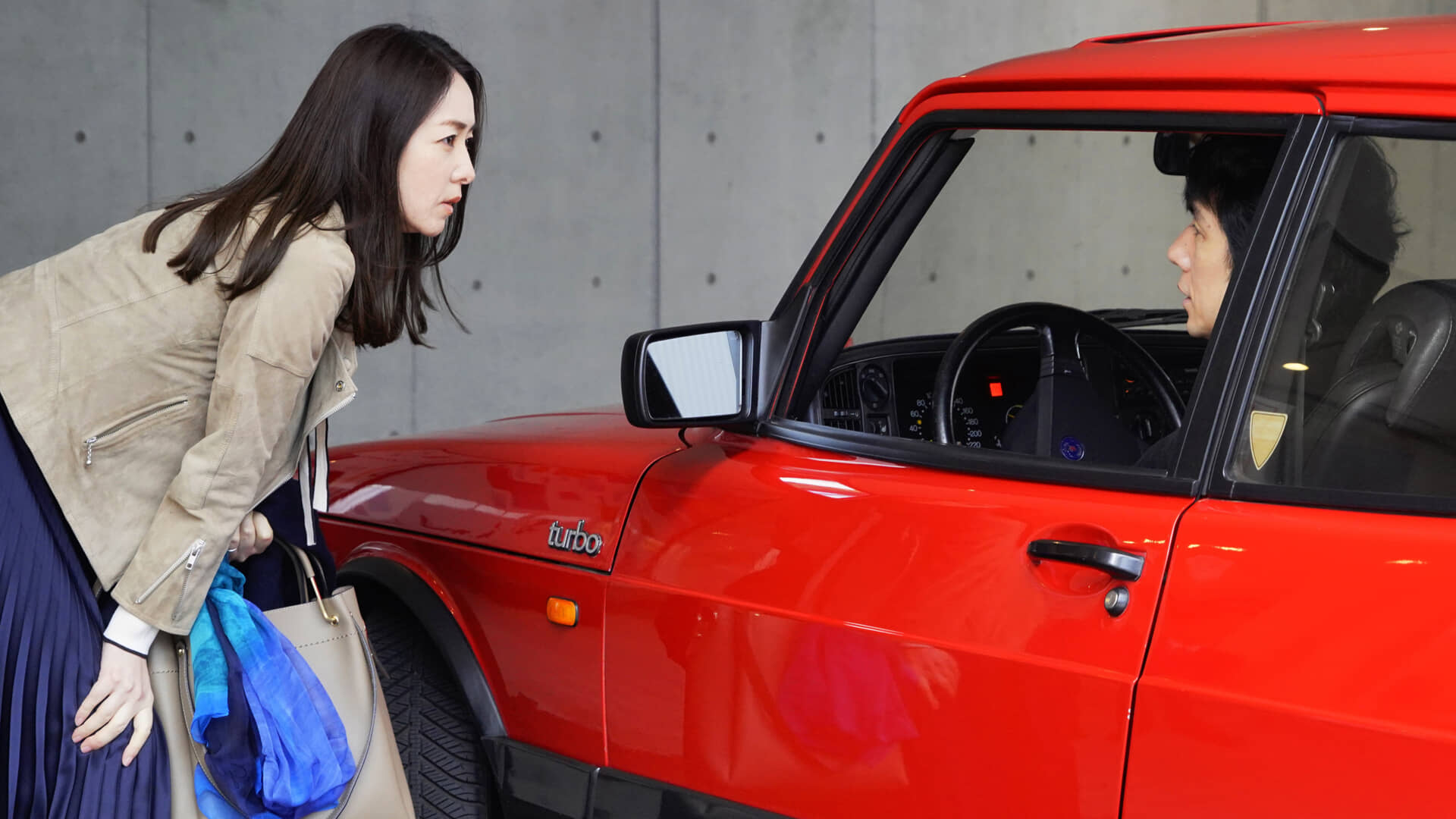
The film’s title also refers to another fundamental element, namely Kafuku’s magnificent red SAAB 900 Turbo. The car is not treated purely as a means of transport, but becomes the backdrop for the most important conversations in which the characters mature and lower their defences. This effect is accentuated by the static shots, which favour intimate dialogue warmed only by the receding city lights, simultaneously creating a metaphor for the past that slowly fades away as the various characters try to understand each other in order to move forward into the future. Moreover, for Kafuku, driving is a real professional ritual, as he constantly repeats the lines from his show in the car, effectively entering a sort of cathartic trance.
Art is another central theme of the film. Kafuku is unable to perform in the play he is preparing because he fears that the role would force him to confront the deepest and most hidden part of himself.
At the same time, other characters develop around the protagonist. Misaki Watari, the young driver assigned to Kafuku, follows a path almost parallel to that of the protagonist. Initially, she appears distant and models her social relationships according to the classic professional model, but gradually reveals herself to be a character in constant development. The two tell each other about the traumas and pains they have experienced in their respective lives, and their relationship evolves into something very similar to that between a father and daughter. Equally significant is the presence of a mute actress, a woman who has managed to overcome her difficulties thanks to the support and love of her husband, and who now acts as a point of contact for others, acting as a real emotional catalyst.
Ultimately, Drive My Car is a film that conceals numerous interpretations within itself, but at its core, it tells us how important it is to trust others, even if these “others” are not necessarily perfect role models. Only in this way can we fix our lives, just like a car that resumes its journey after standing still for a long time.