Liz and the Blue Bird is a 2018 film produced by Kyoto Animation and directed by Naoko Yamada (probably best known to most audiences for her work on the film The Voices of a Distant Bird), focusing on the relationship between Mizore and Nozomi, two close friends who are members of a high school music club.
Although the film is only a spin-off from the world of ‘Sound! Euphonium’, it is not necessary to have seen the series to understand the general context and fully enjoy the story. The introductory part, in fact, focuses exclusively on Mizore, a reserved and quiet girl who waits silently for her friend Nozomi (the perfect embodiment of the stereotype of the lively and popular girl among students) on the steps of their school.
The sequences in which the two, once they meet, head towards the music room already suggest everything we need to know. The shots linger on minute details, such as Nozomi’s fast and chaotic walk (always in the foreground) contrasted with Mizore’s slow and elegant walk (who constantly follows her), as well as the linguistic register adopted by the protagonists. Silence becomes an integral part of the direction and makes every single frame indispensable to the continuation of the story, as the characters express themselves mainly through small gestures, such as stroking their hair, moving a leg back and the facial expressions they exchange.
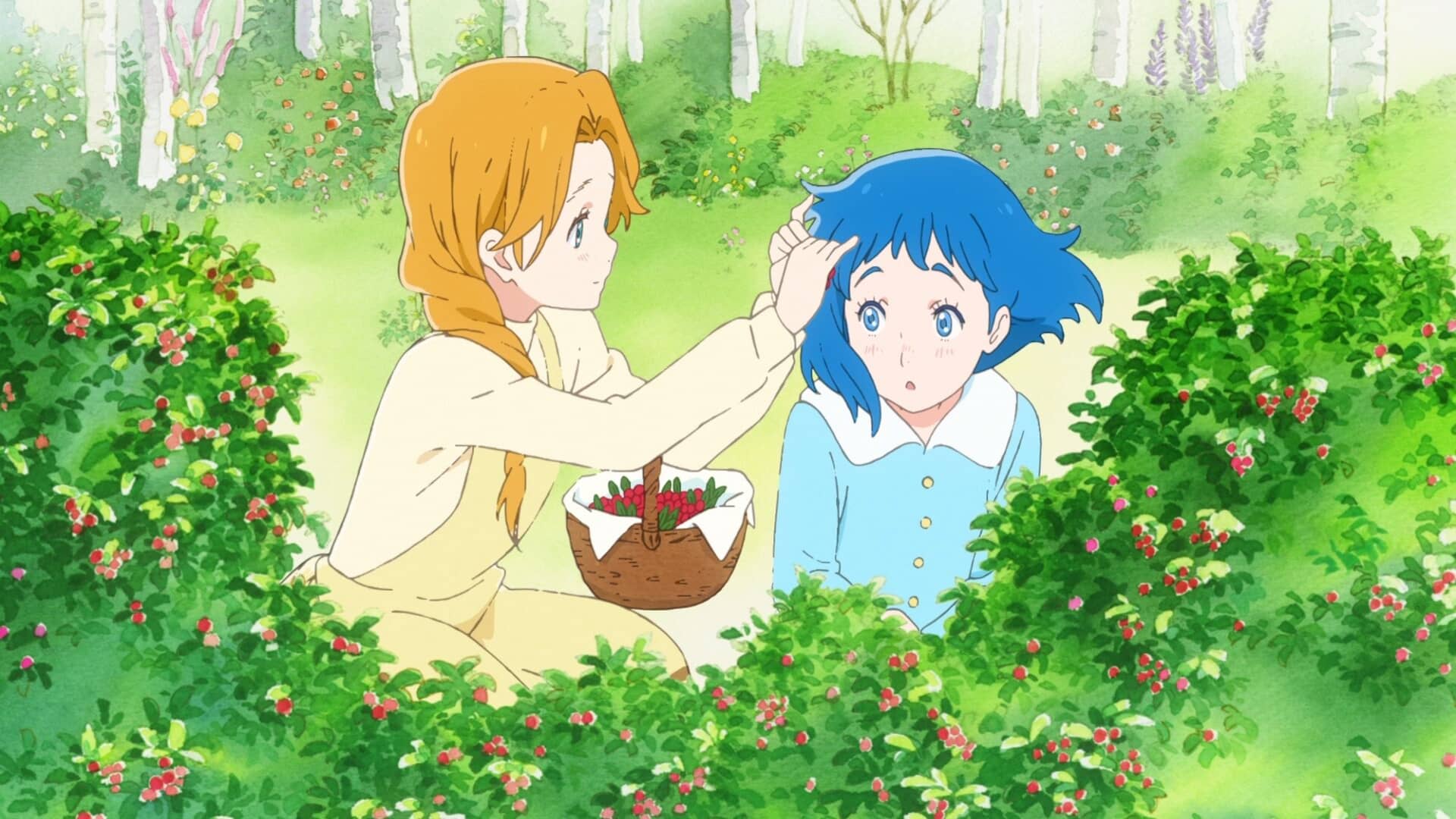
Parallel to the story of the two girls, the story of Liz and the blue bird also takes shape. These are characters from a fairy tale read by Mizore and Nozomi, which recurs constantly throughout the film, creating significant analogies with the protagonists.
The pace of the narrative remains calm and peaceful throughout, accompanying the viewer on a sensory journey of feelings and music. After all, what better way to express one’s emotions than through a musical instrument?
Music is the key to understanding which of the two girls represents Liz and which represents the blue bird.
The technical aspect is of the highest standard. After all, one would expect nothing less from the studio that produced it. The contrast between the traditional design of the modern world and the fairy-tale world, represented as hand-drawn and pastel-coloured illustrations, creates a welcoming atmosphere that gives you goosebumps. The sound is also impressive, as the viewer can perceive the girls’ emotions simply by listening to what they play. At the film’s climax, the evolution of the protagonists is clearly felt as they finally give vent to their true feelings.
The film does not seek a complex narrative structure, preferring to focus on the relationship between the two friends, without weighing down the story with unnecessary subplots. The theme of friendship and love between two people who, despite their deep bond, must learn to go their separate ways, is portrayed with maturity, without subterfuge or forced dialogue.
I invite you to immerse yourself in this film and perhaps discover whether you too can identify with this magical fairy tale.