Dear readers, please be advised that the following content may be seriously harmful to you if you have particular tastes, often justified with phrases such as ‘How can it be bad if it has made so much money??“ or ‘Tastes are subjective!”. so as a precaution, I recommend turning the page and relaxing with a new RAI series to return to your comfort zone. If, on the other hand, you consider yourself intrepid or crazy enough to want to continue, I welcome you to this new review, because what we are going to talk about is truly out of the ordinary and deserves to be told with care.
Studio Mappa’s new work brings to the big screen the arc immediately following the first season of the anime based on Tatsuki Fujimoto’s manga “Chainsaw Man”, published in Shonen Jump since 2018, and fans have had to wait two years to see one of the most beloved and controversial chapters of the saga, but the wait has been rewarded with a grand return that alternates a calm and contemplative first part with an explosive second part made up of fierce fights and spectacular sequences, a contrast that becomes the stylistic hallmark of the entire film.
This alternation of bucolic moments and pure madness is made even more effective by a graphic style close to the original manga, with saturated colours and a less photorealistic design than the animated series, enriched with new scenes that expand the narrative universe and offering new emotions even to the most devoted readers, almost as if the film were a bridge between the page and the screen, capable of restoring the same visual intensity while adding new nuances.
The plot follows Denji and his encounter with Reze, a mysterious girl who becomes the centrepiece of an intense emotional journey, between tender moments and dramatic revelations, exploding into high-level combat choreography. The development of their relationship becomes the beating heart of the story, a journey that is not limited to telling the tale of an impossible love, but also depicts Denji’s emotional growth emotional growth of Denji, his ability to open up, to trust and ultimately to suffer.
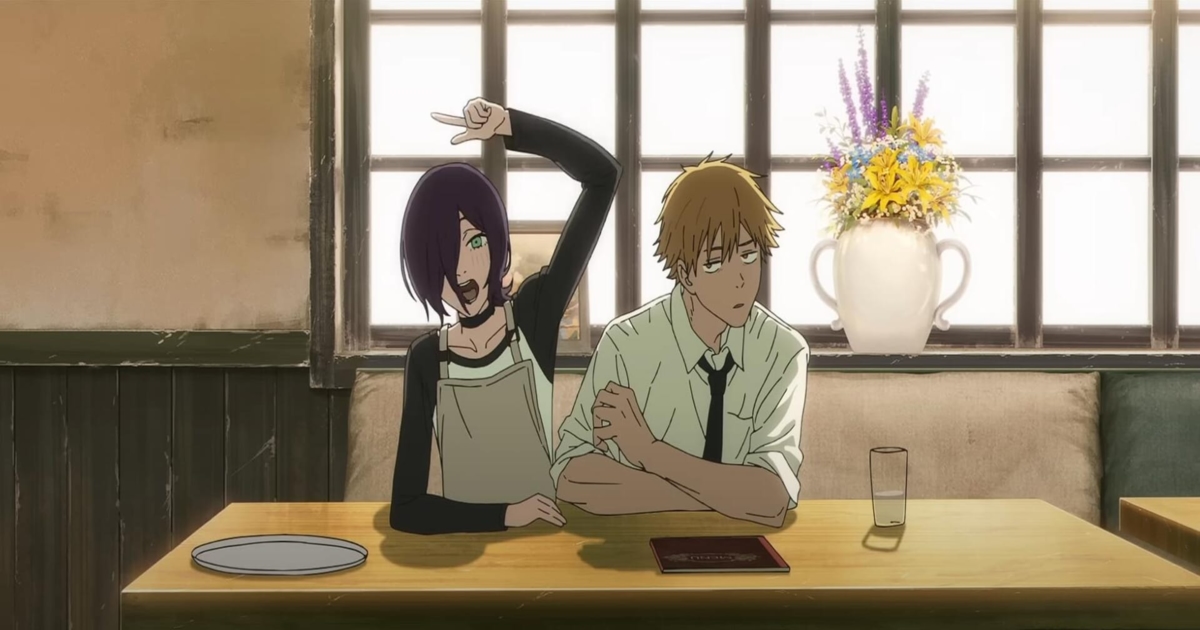
Alongside them we find Makima and Aki, familiar figures who are explored in greater depth here, but also new faces such as Beam, the shark demon, apparently a comic sidekick but in reality a symbol of Denji’s heart and growth, enriching the film with a deep and metaphorical connection that makes him much more than just a supporting character.
Beam becomes almost a mirror image of Denji, with his teeth, his physicality, his direct and spontaneous character, and their relationship, made up of complicity and even clashes, reflects the protagonist’s transformation, his ability to become more like Aki and to mature through confrontation.
Water becomes the leitmotif of the entire film and takes on a symbolic value that runs through every scene: Denji cries in front of a film, discovering the flow of emotions, the rain brings him closer to Reze in a telephone booth, in the swimming pool she teaches him to swim not only physically but in the sea of emotions, and when he is betrayed, it is Beam, a great swimmer and lover of water, who saves him, as if to say that emotional growth is never solitary but always shared.
The ending, with Denji and Reze sinking together, seals this metaphor, showing water as a place of vulnerability and sharing, where the two bond not through strength but through emotions, and it is precisely at that moment that the film reaches its maximum poetic intensity, transforming a fight and a betrayal into a moment of pure humanity.
This film is not only a faithful adaptation, but a film that captures the essence of the manga and transforms it into powerful images, confirming once again the narrative power of Chainsaw Man and demonstrating how Studio Mappa is able to combine spectacle and introspection, action and symbolism, entertainment and reflection, giving the audience a work that does not merely tell a story but invites them to immerse themselves and be swept away.