There are films that manage to bend a myth without breaking it, to reinvent an archetype without dissipating its original magic. ‘Cinderella The Cat’ belongs to this select circle: a fairy tale tinged with the shadows of crime news, touching on the sharp edges of noir and delving into the pulsating and contradictory heart of Naples. No royal balls or golden pumpkins: Alessandro Rak, Ivan Cappiello, Marino Guarnieri and Dario Sansone’s Cinderella wanders barefoot among corroded walkways and corridors of the city’s underground. No royal balls or golden pumpkins: the Cinderella of Alessandro Rak, Ivan Cappiello, Marino Guarnieri and Dario Sansone wanders barefoot among corroded walkways and metal corridors inside the Megaride, a ship-world stranded in the harbour like a sleeping giant. That rusty steel is the funeral monument to a promise of progress never kept, the emblem of a bright future trapped in the meshes of corruption and abandonment.
After the first flashes of memory, composed of the smiling face of a visionary father and the seductive blue light of holograms that preserve the past like fragile relics, the story opens up onto a suspended Naples, motionless in its wound. The Megaride, a metal colossus anchored in the harbour for fifteen long years, is no longer the symbol of a sparkling future projected towards the open sea, but a wreck trapped in the present, populated by sordid intrigues, silent violence and digital ghosts wandering among the metal sheets.
It is in this closed and oxidised universe that Mia lives, a mute girl, alone, prisoner of a silence that protects and isolates her at the same time. Raised under the stern and cold gaze of her unloving stepmother Angelica, surrounded by six daughters shaped by poverty and opportunism, each a distorted caricature of a vice or unfulfilled desire, the girl moves with stealthy agility through the ventilation ducts, invisible like a cat that has learned to survive by staying on the margins. From the shadows, she scrutinises the world that has been denied her, holding within herself a mixture of fear and resistance that seems to be waiting only for the right moment to explode.
Angelica’s power is not based solely on her domestic cruelty, but has deep roots in her love affair with Salvatore Lo Giusto, known as ‘o Re, a man who has made unscrupulousness and corruption his art. A criminal underworld wheeler-dealer, capable of sniffing out weakness like a shark senses blood in the water, Salvatore bends every inheritance, every asset, every person to his ambitions. Their union is a toxic fusion of private greed and criminal power: under their influence, the Megaride is desecrated, transformed from a laboratory ship into a brothel, from a technological dream into the beating heart of illicit trafficking and money laundering.
Meanwhile, outside its metal walls, the city slowly slips into what seems like irreversible decline, as if the corruption of the ship were a mirror of that of the city. Yet, amid the thick cigarette smoke, dirty alleys and resigned silence of the people, an underground pulse survives: the memory of a project that could have carried Naples towards a bright future, and which still lingers in the memories, holograms and eyes of those who have not stopped believing that a different future is possible.
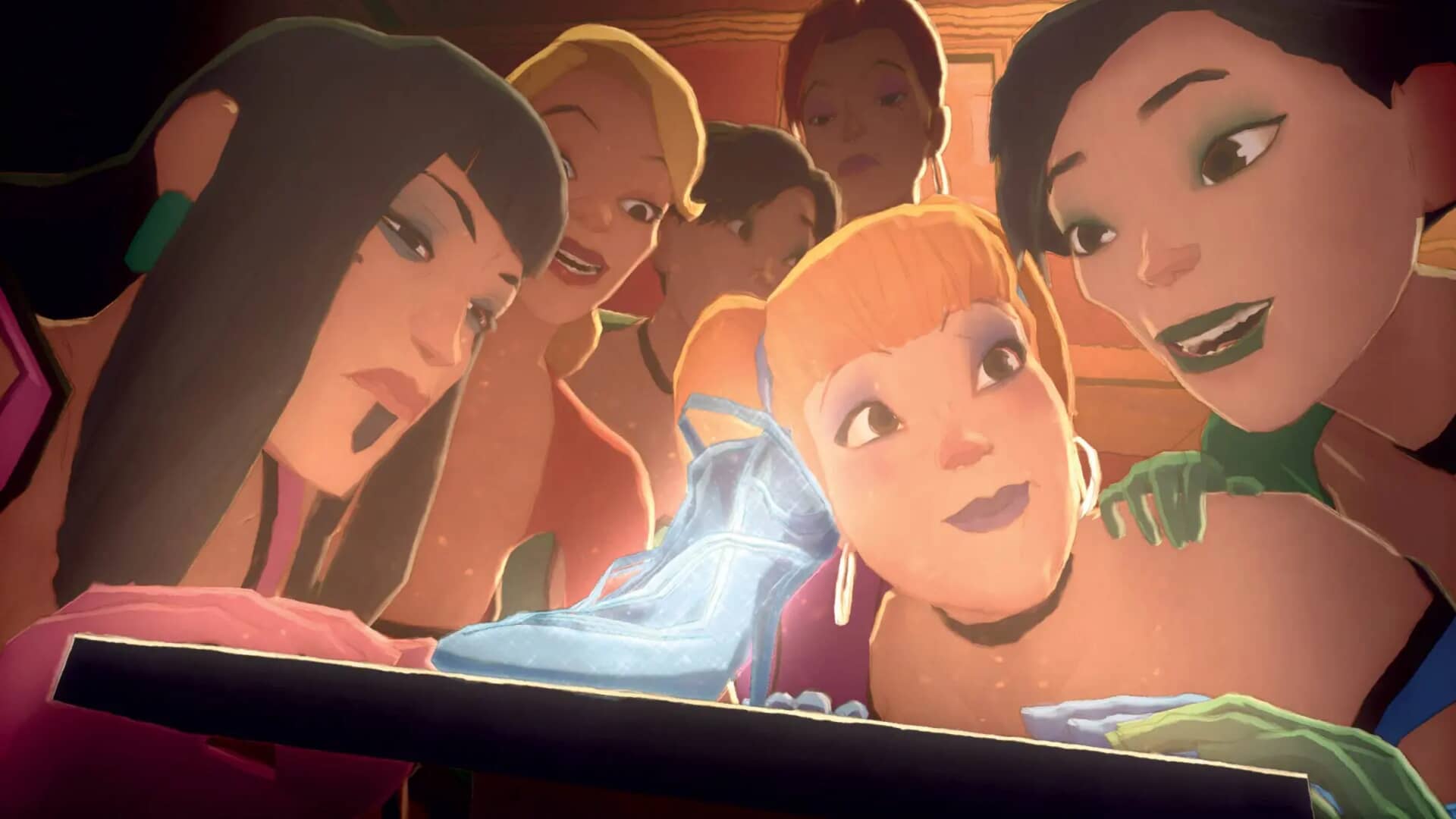
The film works through contrasts: Vittorio Basile’s visionary nobility, who wanted to use technology as a bridge to progress, is contrasted with Salvatore’s blind greed, committed to shaping a kingdom of crime. In between, there is the stubborn resistance of Primo Gemito, Vittorio’s loyal bodyguard, whose courage seems to be the only barrier against the moral and material destruction of the city. His figure, standing tall like a pole in the middle of a storm, suggests that loyalty to ideals is still possible, even when everything else collapses.
The Naples of ‘Cinderella The Cat’ is not just a backdrop: it breathes, suffers and sings. It is gloomy in the cold shots, saturated with shadows and rain, but it vibrates in the musical interludes and in the dialogues that carry the Neapolitan cadence as a sign of identity. Every glimpse of animation is carefully crafted to convey the ambivalence of a city suspended between damnation and redemption: the noir of dead-end streets coexists with sudden flashes of colour, as if hope could still burst in treacherously.
In terms of production, ‘Cinderella The Cat’ is a shining example of how ingenuity can transform limitations into possibilities. Created using Blender, enhanced with customised software modifications and then shared with the entire creative community, the work embodies an open and generous work ethic, in which technical innovation becomes a collective asset. It is proof that, when there is a clear vision and a passionate team, a lack of resources does not stifle ambition, but refines it, forcing bold and unconventional solutions.
The dubbing adds an emotional layer that amplifies the narrative effectiveness. Alessandro Gassman lends Primo Gemito a measured gravity that vibrates with loyalty and melancholy. Massimiliano Gallo enjoys exploring Salvatore’s lucid madness, oscillating between seductive charisma and looming menace. Maria Pia Calzone sculpts the figure of Angelica with cold harshness and disturbing complexity. The rest of the cast, from the femminiello Luigi to Angelica’s daughters, chisels vocal nuances that make each character immediately distinguishable: a chorus of voices where no note is out of place and which, together, amplifies the choral nature and emotional density of this dark fairy tale.
The soundtrack, supervised by Luigi Scialdone and Antonio Fresa, is a tapestry of sound that intertwines romanticism and disenchantment, a musical thread that accompanies Mia along her journey suspended between hope and disillusionment. The original tracks, like melancholic waltzes that seem to dance on the edge of a dream destined to shatter, interact with inserts by artists such as Enzo Gragnaniello, capable of distilling the contrasting feelings of Naples into a few notes: a mixture of pride and hurt, passion and surrender. It is music that does not seek to sugarcoat reality, but envelops it, giving it a sensory form, lingering like salt after a storm at sea, when every breath carries with it the taste of what has been.
In this interweaving of sounds and images, ‘Cinderella The Cat’ reveals itself to be a work that, while based on a universal archetype, speaks with urgency and lucidity to the present. It is a Camorra fairy tale, in which the stakes are not the fate of a single protagonist, but that of an entire community, with salvation entrusted to the determination not to give in, even when silence becomes the last possible defence. A story that does not promise easy happy endings, but which shows, without ever looking away, the need to hold on to a glimmer of resistance, even in the heart of the longest night.