If I had told you that the same studio behind ‘The Emoji Movie’ would produce a film about a K-pop band that defeats demons with music, you would probably have burst out laughing.
And I don’t blame you.
Yet ‘Kpop Demon Hunters’, released on Netflix in June 2025, has managed to establish itself as one of the platform’s most viewed titles, creating a surprisingly active and passionate community around it.
And yes, I admit it: it impressed me. It’s not perfect, but it works.
The film follows the adventures of the Huntrix, a band descended from a dynasty of demon hunters. Their weapon? Music. An idea that sounds absurd on paper, but which manages to find its own internal coherence in the context of the film. The story is not particularly innovative, after all it is about self-acceptance, friendship and a touch of romance, but it is told with a rhythm and style that make engagement its strong point.
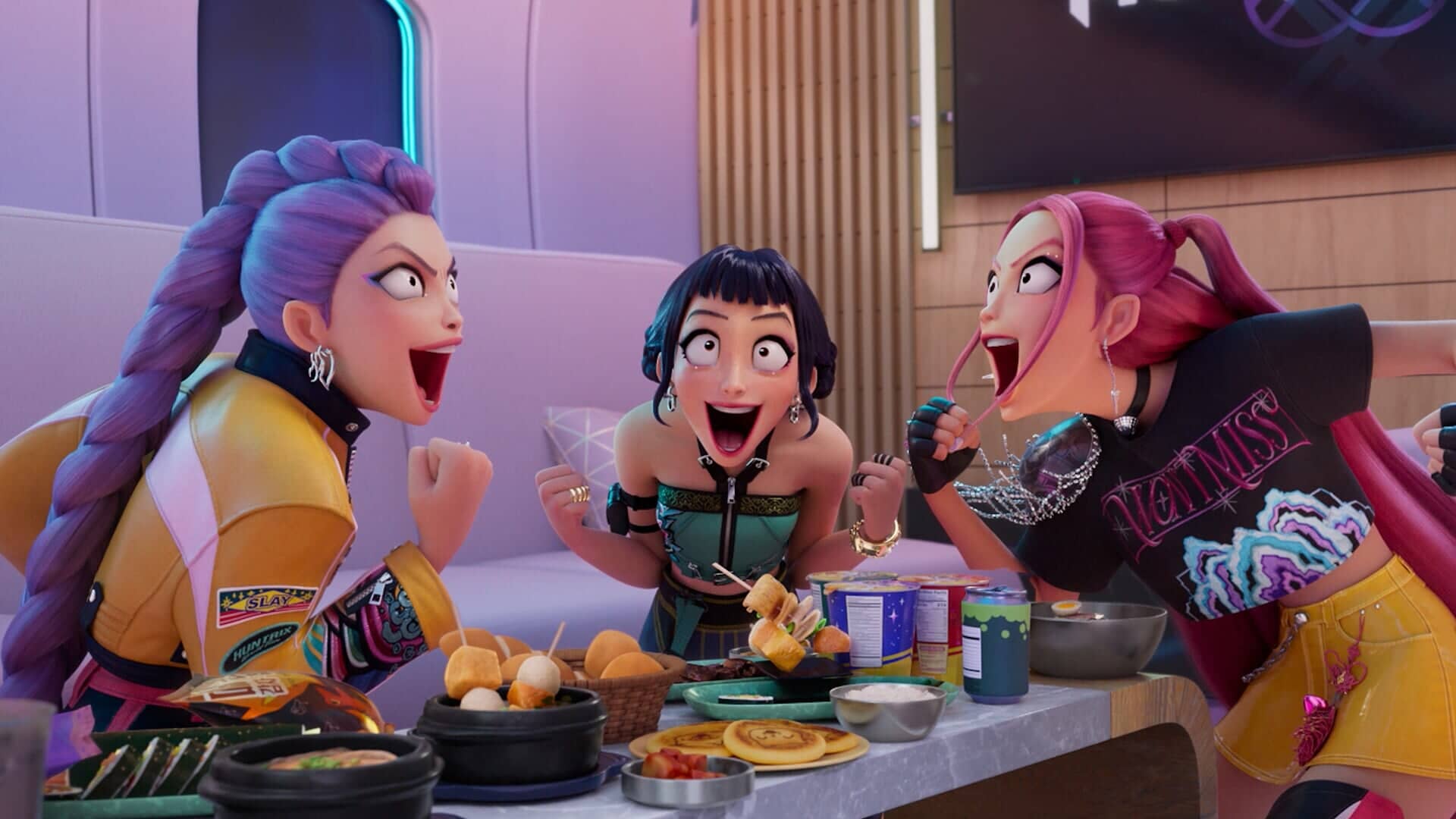
What is surprising is the film’s ability to get us in tune with the protagonists right from the start. This feeling is amplified by a frenetic beginning, practically inundated with continuous music (perhaps a deliberate choice to create a subtle satire on the music world, always on the hunt for the next hit?). Fortunately, the narrative slows down and allows us to explore the emotions of our group of hunters. In particular, the friendship between the girls is depicted through a series of scenes that highlight their transparency and the reassurances they give each other to face their fragilities. They are not perfect superheroes, but normal people who support each other, becoming a family in which each can show their most vulnerable side.
Rumi’s character is perhaps the most interesting, after all she is the protagonist of the film. Her secret, hidden from her friends who depend on her, becomes the focus of the story. The loss of her voice seems to be linked to her relationship with shame and self-acceptance, and it is precisely this latter characteristic that will be the turning point of the film. It is a beautiful message about self-esteem, made effective by extremely simple but sincere writing. Rumi is not a contrived heroine, but a person with whom we can identify.
Moving on to the purely technical side, once again Sony Pictures Animation has hit the mark. Jokingly, though not entirely, I could say that Sony is taking animation into new uncharted territory with its fresh and distinctive styles, while its parent company Disney seems to be struggling. The visual style moves away from realism (although present in the details of costumes and choreography) and embraces a strong identity, with facial expressions reminiscent of Japanese comics and an eye-catching alternation of colour palettes.
Of course, not everything works perfectly. The antagonist band is the film’s weak point: its members, except for the leader Jinu, are poorly developed and seem like extras used only for performances. It’s a shame, because more in-depth antagonists would have made the story even richer, but perhaps that wasn’t the goal. After all, the film seems to be telling us that the real barrier to be broken down is the one that prevents us from being ourselves. It invites us to go so far as to destroy it to make room for something new.
In summary, ‘Kpop Demon Hunters’ is a delightful experience. Do not be misled by the somewhat absurd opening, because behind the lights, glitter, and exaggerated jokes, there is a story about friendship, acceptance, and growth. And even if the plot doesn’t revolutionise the genre, it manages to make you feel something: a smile, a song in your head, or simply the urge to dance with the Huntrix.