‘The Brutalist’ is Brady Corbet’s new film starring Adrien Brody, a duo that certainly needs no introduction.
This film is monumental in every respect, so much so that it seems like a blockbuster. The fact that it cost “only” ten million and was shot in a month makes it even more impressive, despite the fact that the Italian dubbing does not do it justice as well as the original version.
The plot revolves entirely around the figure of architect László Toth and his escape from post-war Europe in 1947, seeking his fortune in America.
The film opens with the iconic opening sequence showing the Statue of Liberty upside down, symbolising both the salvation and freedom typical of the American dream, but also the macabre truth that will be revealed throughout the film.
From the outset, it is clear that The Brutalist is not a film like any other, but aims to establish itself as the film about immigration. It is no coincidence that the opening sequence is accompanied by the voice of the protagonist’s wife reading a letter in which he talks about freedom, using a quote from Goethe:
‘One has only to declare oneself free, and in that very moment one feels constrained. Just have the courage to declare yourself limited, and you are free.’
The story continues by showing Toth’s daily struggles, highlighting how difficult it was even just to arrive on time at the free canteens for a meagre meal.
The real turning point comes with the introduction of patron Harrison Lee Van Buren Sr., brilliantly played by Guy Pearce.
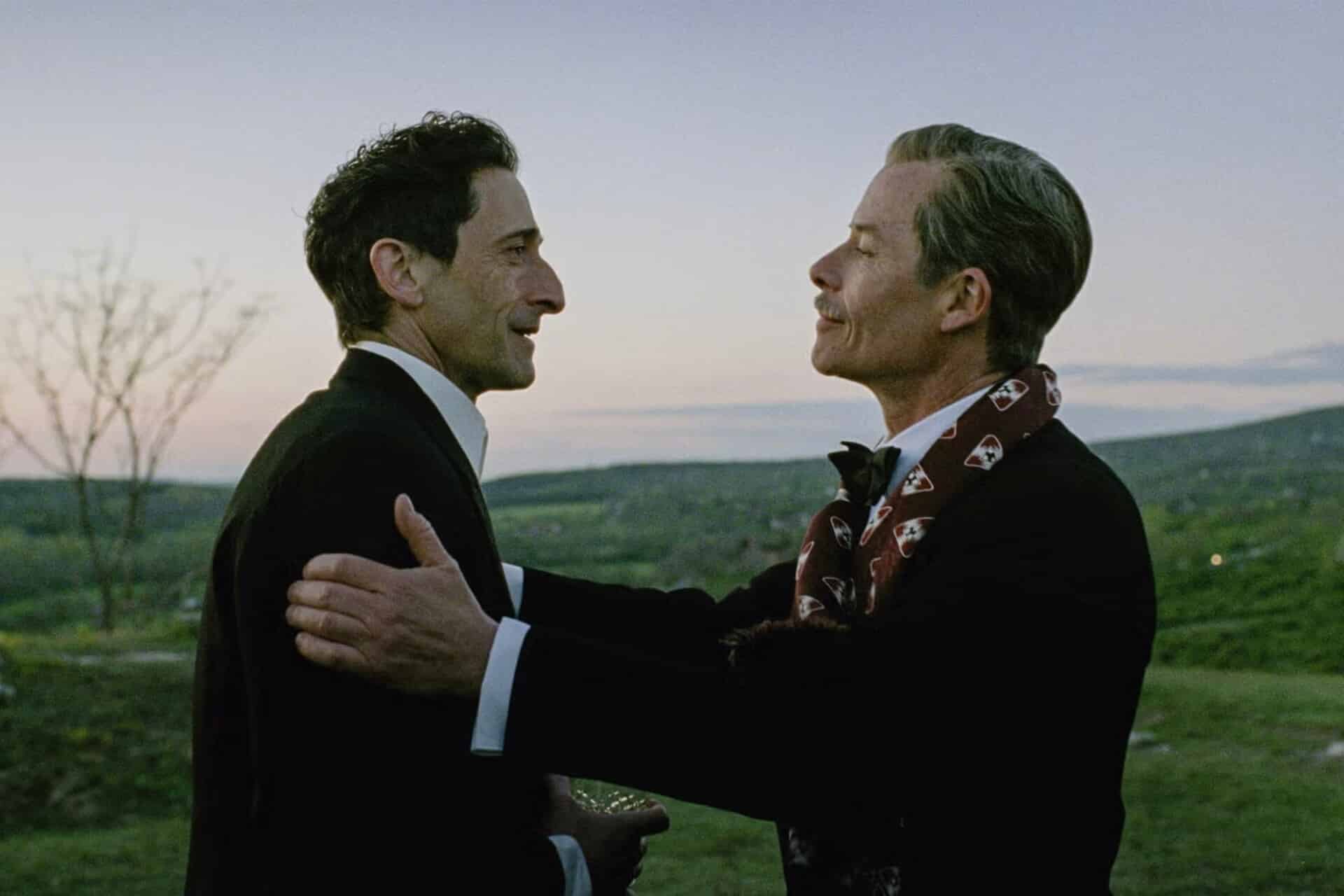
This character represents America in its most capitalist and cultureless form, especially when he claims to find conversations with Toth “intellectually stimulating”, while admitting that he does not possess much culture himself.
It is precisely in this passage that one of the most powerful symbols of the entire film emerges, namely, a vision of America focused solely on capitalist power, which, despite being an economic and industrial superpower, can do nothing but pale and bow (not without envy) before the European artistic conception.
It is precisely this “toxic” relationship between the two characters that clearly shows how the patron considers art to be merely a means of improving his position, going so far as to feel entitled to possess even the artist himself.
This film not only tells the story of a brutalist architect, but also embodies the style itself in every detail. Every single aspect of the film manages to be both minimalist and maximalist, depending on the events.
The soundtrack, composed of simple but effective sounds, accompanies the viewing experience impeccably. The direction skilfully uses continuous shots alternating with frequent cuts, creating a visual rhythm that mirrors the pace of the plot.
The decision to shoot in VistaVision format adds an extra layer of beauty and simplicity to the film, making it simple, natural and pleasant to watch, just like the bare concrete in Brutalist architecture.
In general, it can be said that Brady Corbet was a perfect brutalist architect in the making of this film, managing to transpose the spirit and aesthetics of the movement onto the screen in an extraordinary way.
Ultimately, ‘The Brutalist’ is one of the most beautiful and engaging films of the year, if not of the last decade. The film maintains a well-constructed pace that makes its three-and-a-half-hour running time fly by, perfectly combining extraordinary performances and flawless technical execution. Brady Corbet has created a work of art that leaves its mark, making ‘The Brutalist’ a must-see for film enthusiasts.